You may have heard the expression that “history is just one damned fact after another,” hopefully as a criticism rather than an endorsement. Or you might subscribe to the idea, attributed to Henry Ford that “history is bunk,” although if you are reading this it’s unlikely that you agree. At the time this is being written, in 2019 the question of what constitute facts has a stark and somewhat distressing political relevance, certainly in the U.S. and perhaps around the world. Given that one of the frequent complaints that I hear as a teacher is that history is just a bunch of facts and dates (and sometimes people, usually white men) it is important, perhaps necessary, to explore what we mean by facts when we are studying and talking about history.
To begin considering what constitute historical facts, let’s go way back, to Paleolithic times and look at an image from the Lascaux caves in France. While we can’t be certain (more on this in a bit) it’s likely that images like this one are approximately 17,000 years old. They were created before agriculture and before writing, so we don’t have the words of the artist to tell us what the image means or why it was created. And yet, there are some statements we can make about it that we can be confident enough to call “facts.”
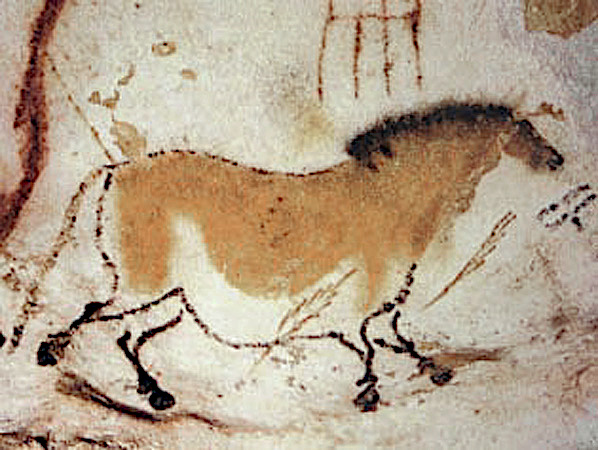
There is at least one thing we can assert about this image that is beyond question: the person who made it had access to pigments and knew how to apply those colors to the surface of a wall. That the image exists and that it consists of at least two colors laid out in a non-random pattern is enough to call its creation by a person who had access to and knew how to use pigments a “fact.” Based on the existence of the image itself we can assert two more historical facts. First, that long-ago human beings knew how to use pigments to create images and second, that they did so. Another way to say this, a way that might appear in a textbook is that, in Paleolithic times, some human beings created images on the walls of caves.
Because these facts are proved by the existence of the thing being described, I think of these as existential or first-order facts. These are the items we can say with nearly 100% certainty exist and were created at the time they originated. Unfortunately, many of these first order facts are, like the statement that the cave painting exists and was created by someone who knew how to create paintings in a cave, rather obvious and don’t tell us much that we really want to know.
So far so good, but is that all we can say with enough certainty to call our statement a fact? And even if we can agree that the above statement is true, so what? Don’t we want a little more than bare assertions of the existence of things? Is there anything else we can say about this image with enough confidence to call our statement a fact?
An important note about “important”
Teachers and students are both intimately familiar with the word important and its cousin, significant. I will be expounding on significance in a later chapter, but for now a word about important. It is a frustrating word because it says a great deal and nothing at the same time. When students (or teachers or textbooks) say that something is or was important, they are making a self-evident statement. Why would you bring it up if it wasn’t somehow meaningful, either in the moment or in your understanding of what happened in the past? Everything we say or write down has some importance, otherwise we wouldn’t say it. So when a student writes at the beginning of an essay, “Confucian ideas were very important in Chinese history,” they really aren’t saying much at all. What teachers, and historians, probably, want to know is why, this thing – Confucianism in Chinese history – was meaningful to people in the past and is meaningful to you now. The first question requires an act of imagination – it is difficult to really be certain why something or someone was meaningful to people living at the time it came about or lived – but the second question should be able to be answered. And answering that question, why is this thing we are learning about right now “important” is the essence of learning about history.
Getting back to the cave painting, there are other things we can say about it that, while not as concretely factual as statements of its existence, are so likely to be true that we can effectively say that they are facts. I call these inferential facts or virtual facts, and here is an example. One thing we can say with almost 100% certainty is that whoever made this image took some time and effort to do it. It’s in a cave, for one thing, and it would have taken some illumination for the artist to see what they were doing. Time spent making this image was not time spent finding and preparing food, so we can say that either the person who made it had enough food available, or that making this image was so important that they were willing to be hungry, at least for a little while. Either way, that someone took the time and energy to make this image shows that it was important to them because in general humans don’t do things unless they have some meaning, some importance although the exact nature of that importance is much more difficult to determine.
We have further inferential evidence that image-making was important to whoever created our cave horse. It’s in a cave. This suggests multiple inferential facts. First, the presence of this image is in a cave reinforces our suspicion that it was meaningful to the person who made it. Not only would it be difficult to make this painting in a dark cave, but putting it there probably means that the artist wanted it to be preserved. If so, they succeeded beyond their wildest dreams. We shouldn’t take this for granted. It’s probable that much of the evidence of their lives that humans have created over the past fifty to one hundred thousand years is gone, having been created to be used outdoors or without a thought for its permanence. But whoever made this knew it was going to last. Not only that, it was not meant to be seen all the time because it was made in a place that was, and still is, largely inaccessible. All of this together leads to a reasonably solid conclusion that image-making like this was very meaningful to the individual who made it and probably also to the community for which it was made.
So what sort of historical “facts” do we have based on this one piece of evidence, and does thinking about what constitutes a fact help us better understand the process of making and understanding “history”? Beyond the concrete and inferential facts laid out above, we can say for certain that there were people living at the time and in the place that the image was made, somewhere between 17,000 and 15,000 BCE in the southern part what is now known as France. It is highly likely that whoever made this was living near the caves that it was found semi-permanently because of the time and effort that it took to make the painting, although it is possible that the caves were an important space that nomadic or semi-nomadic people would return to over and over. To add detail to our picture, however, we need not only to rely on our historical imaginations, but to pull in information from other disciplines and modes of thought.
Modern scientific techniques can be particularly useful when trying to explain the remote past, especially when it comes to figuring out when something happened. By using radiocarbon dating techniques, we can determine, within a few hundred years, when an artifact was made, or when we find skeletal remains, when a person was alive. In the past 20 years, DNA sequencing has provided us with a great deal of information about the movement of early humans across the globe, although many of these conclusions are controversial and more importantly are based not only on analysis of genetic material but also on complex mathematical models.[1] Mathematics, especially probability, is incredibly useful in helping us create pictures or models of the past, at the most basic level because some events are more mathematically probable than others. A concrete example is that it is highly improbably to find any human being whose lifespan is greater than 115 years, so we can say with a high degree of confidence that when we find a skeleton, it belonged to someone who died before they reached the age of 115. Scientific analysis of the growth patterns in teeth and bones, can help us narrow this age range down, for example we can easily tell the difference between the skeletons of an infant and a fully-grown woman or man.
You have most likely noticed that I have been using terms like probably, likely and perhaps in this discussion, and that’s no accident. History books have a tendency to treat events in the past and the factors that caused them to happen as certainties. But I have suggested that the number of useful things that we can say about the past that we know with 100% certainty is pretty small. If we can only treat 100% certainties as facts, there isn’t all that much we can say about the past. Those “facts” I designated as inferential or second-order facts are really just descriptions that, when we examine them closely, have a high probability of being true. Are they absolutely 100% certain to have happened the way we describe them? No, but in order for us to move further in our understanding of the past we have to take some (quite a lot) of things that are very likely to have happened the way we say they happened and call those things “facts,” or “true.”
Before we get into hair splitting about what exact percentage of certainty we need to have in order to say that something in the past actually happened the way we say it happened, it’s time to look at a third type of statement that is often presented as an historic truth, but that I would say is an opinion masquerading as a fact. Often these fall under the rubric of “common knowledge” or things that “everybody knows,” but these are the facts you need to be most careful around.
Some of these facts-that-are-really-opinions are overtly political and thus easy to spot. The options here are almost limitless, but, since I am in the United States and most Americans take a fair amount of U.S. history while they are at school, I’ll start with an example from U.S. history. Here’s a statement you might find in a U.S. history textbook:
The United States is one of the world’s most durable democracies, having lasted since the ratification of the U.S. Constitution in 1789.[2]
That sounds pretty official and factual, doesn’t it. It even has a start date and although we might quibble with whether 246 years is a long time, when we consider that there wasn’t a Germany until 1870 or a China not ruled by a dynastic emperor until 1911, or that the Soviet Union only lasted from 1917 to 1989, the U.S. seems to have had a pretty good run. There are a number of ways that this supposedly factual statement is problematic however. The first is the question of duration, which goes against what I just said. Yes, in terms of modern nation-states the United States has a decent record of longevity, but that’s a reflection of our bias towards the present and towards what we know. Sticking with Europe, the French Bourbon family ruled from 1589 to 1792, with its most famous king, Louis XIV ruling for a whopping 72 years! 203 years is a long time for one family to rule over a country, but if you consider that the Bourbons were a subsidiary line of the Capet family, and the Capets ruled France[3] beginning in 987, then you can plausibly say that France had a Capetian king for 805 years (if I did my arithmetic correctly.)
But the question of duration isn’t even the biggest problem with considering our statement about the U.S. a fact. That comes from the question of what it means to call a polity[4] a democracy. Democracy comes from the Greek words kratia for “power” or “rule by” and demos, which is usually translated as “the people,” so it is reasonable to define it as rule by the people, as opposed to by a monarchy (rule by one person) or an aristocracy (rule by ‘the best’). I’m not sure what rule by the people looks like in practice, but in the U.S. we have a representative democracy, which suggests that “the people” chose representatives who rule. Now it is certainly the case that in the U.S. there have, since 1789, been a group of people who have voted to choose representatives, and in most cases the person receiving the most votes went on to be the representative of those who voted for him (or sometimes her, but mostly him). So in the strictest sense American representative democracy can be considered government by the people.
It is also true however, that for the first 130 years or so in the United States, in most states, about half of the population – the half that fall into the category of “women” – were usually not permitted to vote, which means that, by definition, only half of the “people” participated in the process of choosing the leaders. When we further consider that until 1965 a significant percentage[5] of people of African descent were in many places legally barred from voting, as were many people with Asian ancestry, and people who had emigrated from other places, it mathematically certain that far less than 50% of “the people” were responsible for choosing representatives, and this is without even considering that well into the 19th century in order to be able to vote men had to possess a certain amount of property.
Does this mean that the U.S. should not be considered a democracy, at least not before the passage of the Voting Rights Act in 1965? Some would say that it is categorically not a democracy, but my argument is rather that whether we call a polity democratic or not should depend on the level of political participation that exists there. As a rule of thumb, the greater the degree of participation (or put another way, the more people who are allowed to participate, whether or not they actually do) the more democratic the polity is. By this measure the U.S. is more democratic now than it was in 1789, or 1860, or 1900, or any time before 1965, but that doesn’t mean it is a democracy.
Even a relatively anodyne statement about the United States being a democracy turns out to be much more that a simple fact. I’m sure that for many people, although perhaps not many readers of this blog, that statement about American democracy is true enough to be considered an historical fact, but I would suggest that it shouldn’t be, or at least that we need to be more cognizant when we declare that it is. This is just one example of an issue that I’ll be returning to over the course of these posts – how do readers and students decide which interpretations to treat as so likely to be true that we can comfortably call them facts. It’s a huge challenge and one that can make learning history very frustrating, but it can also add a necessary degree of personal agency and commitment to the process of learning because it means that you as a learner can take ownership over what is “history.” This is not to say that you will always be correct in your assertions about the past – I’m certainly not – but I do hope that if you approach the history that you read and see critically, perhaps skeptically, but definitely with an eye towards distinguishing between first, second and third-order “facts,” you will find the process of learning history more engaging, enjoyable, and perhaps even liberating.
[1] I have a lot more to say about this in a later post.
[2] This is NOT actually something I found in a U.S. History textbook. I promise. No copyright violations here.
[3] I know, I know it’s a big stretch to say that the Capets, Valois and Bourbons ruled over a thing that we now consider “France,” but you’ll certainly find Capets, Valois and Boubons referred to as French Kings, which is really the point I am making – questions of what a territorially integral polity that we now call a nation-state or a country is are really difficult to pin down, which is why referring to them or the phenomena accompanying them as facts is rather tricky.
[4] JARGON ALERT! “polity” is a term I use A LOT as short-hand for a territory organized under a political regime. It’s really useful and definitely a term teachers and students should become familiar with.
[5] At the time of writing, it’s about 12%, but that number has varied over time.

 EPIC past